Reset a forgotten password
Forgot your password? With a recovery email set, you can choose a new one from the sign-in screen. What a reset does and does not do to your mail.
Private.Ki does not store your password, so nobody can look it up or send it to you. What you can do is set a new password — if, and only if, you added a recovery email address while you still had access. The reset happens on the sign-in screen and takes three steps.
A password reset changes how you sign in. It does not touch the encrypted copy of your private key. What that means for your mail depends on your unlock method:
- Passphrase. Your key is protected by your passphrase, not your password. After the reset you sign in with the new password, enter your passphrase as usual, and everything is there.
- Password only. Your key is protected by a secret derived from your old password. The reset does not re-encrypt it with the new one, so a device that is not already unlocked cannot open your mailbox after the reset — the unlock step fails. See Password-only accounts below before you reset.
Nothing here can recover a forgotten passphrase. See Your passphrase.
Reset your password
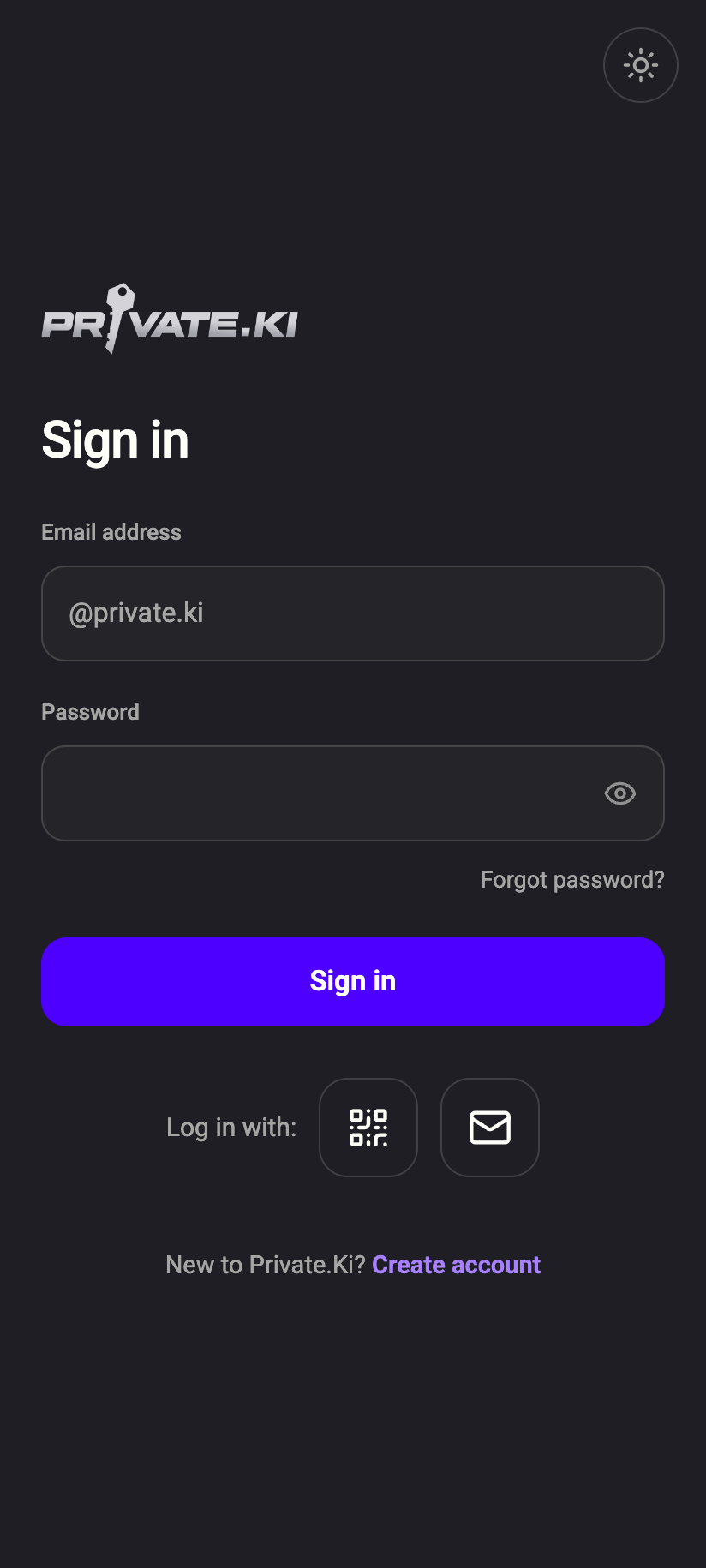
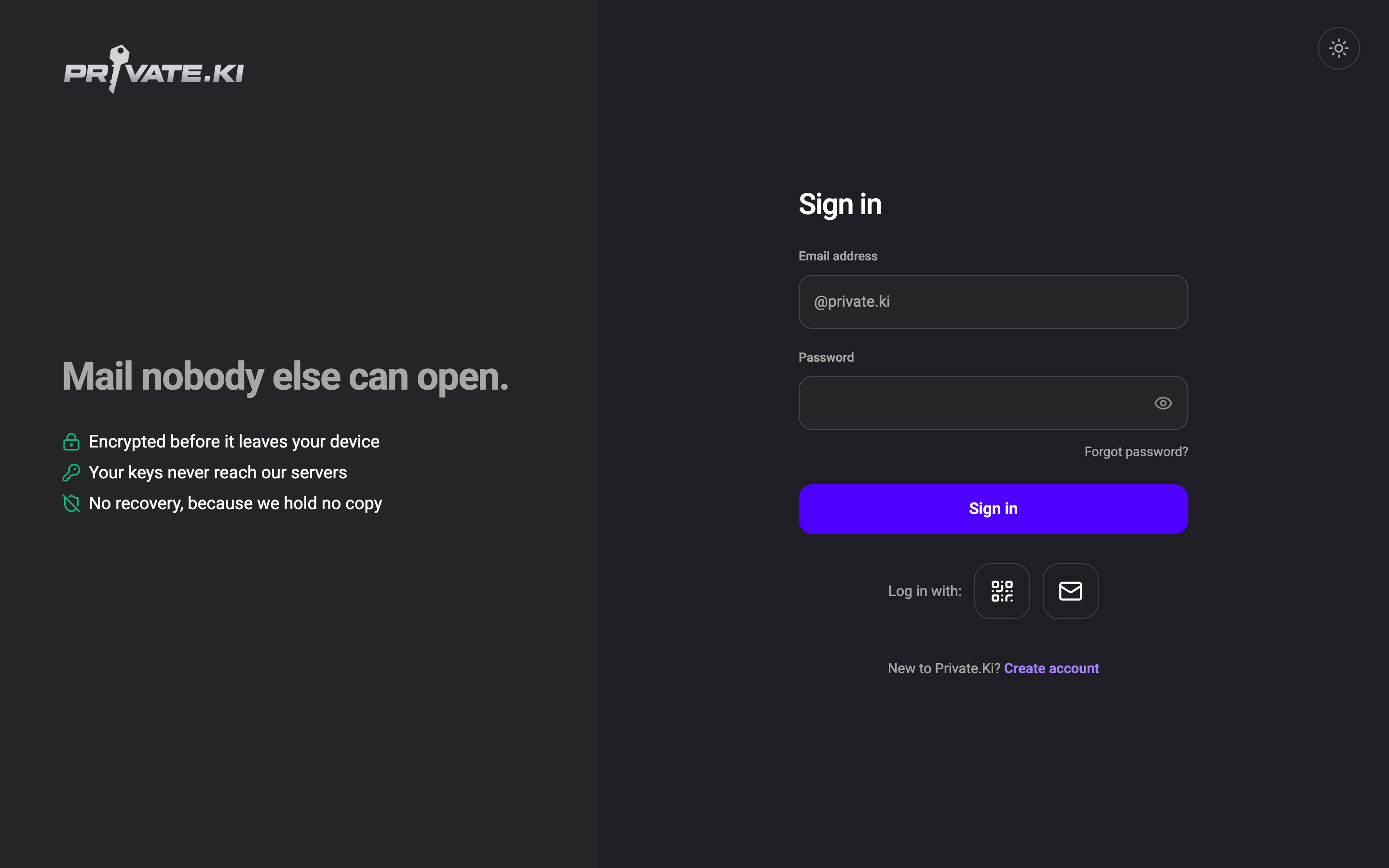
- On the sign-in screen, click Forgot password? under the password field.
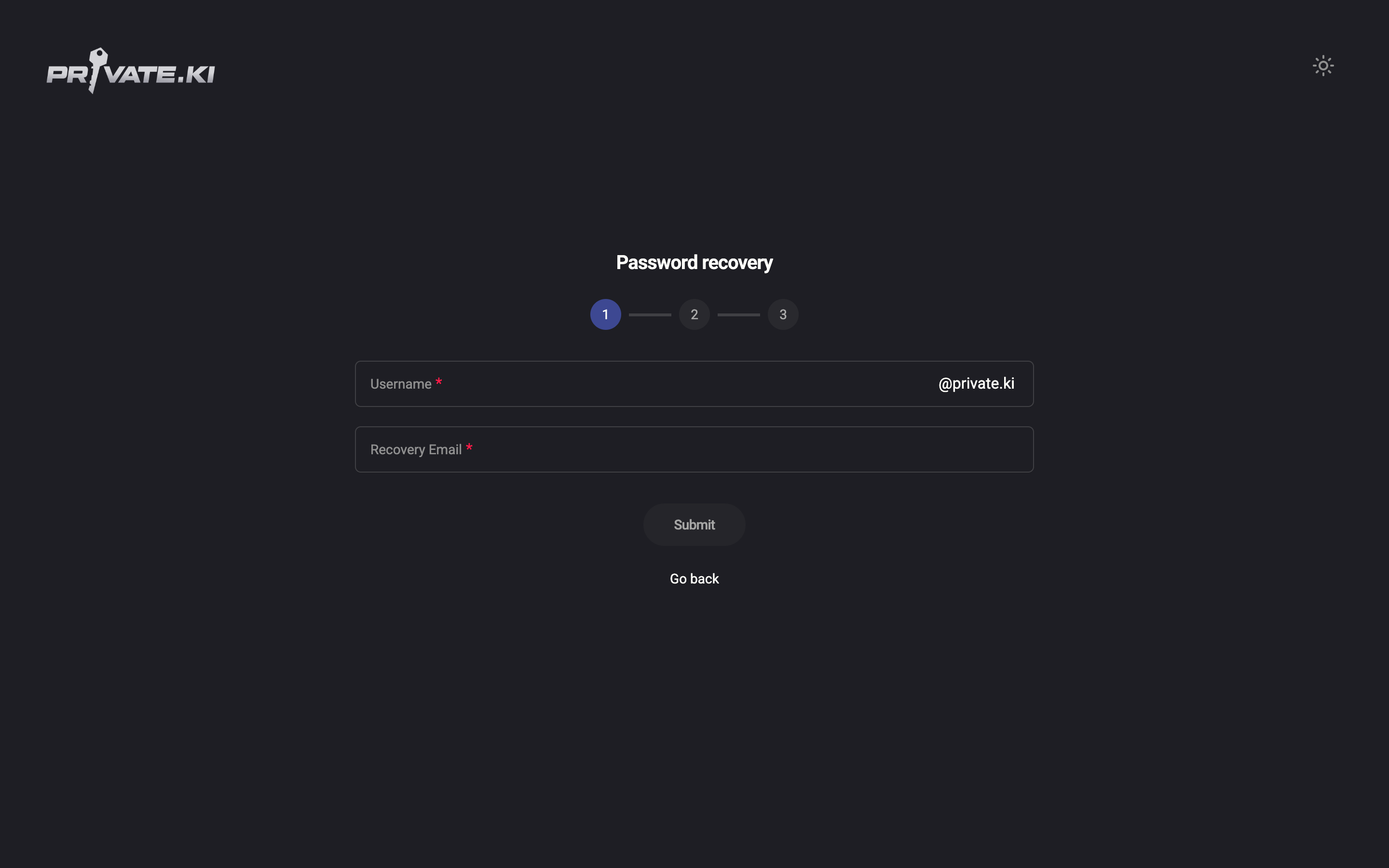
- Step 1 of 3 — Password recovery. Enter your Username and the Recovery Email you set earlier, then click Submit. Because we store only a hash of the address, you have to type it; we cannot fill it in.
1Step 1 of 32Username3Recovery Email4SubmitWeb & desktop 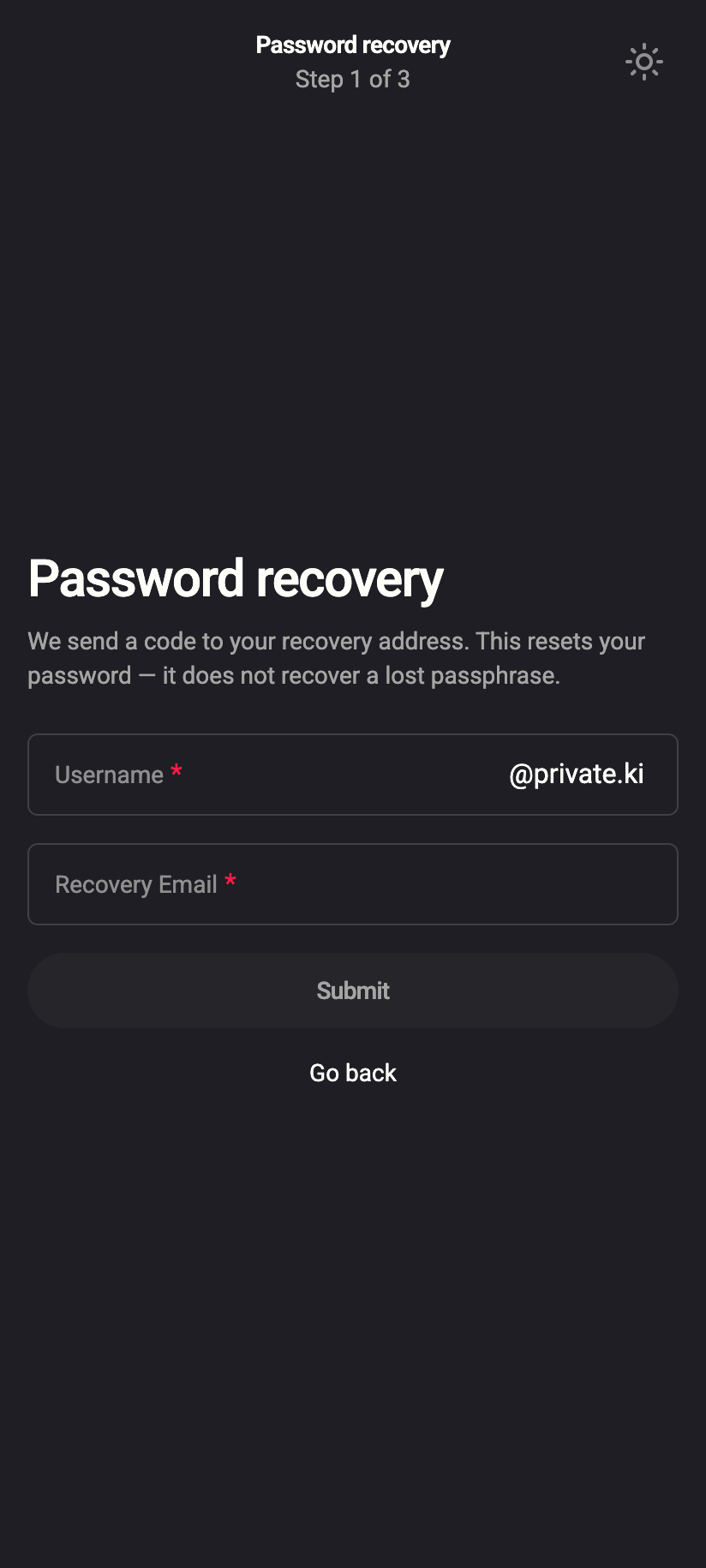 12345
123451Step 1 of 32It does not recover a lost passphrase3Username4Recovery Email5SubmitiPhone 123451Step 1 of 32It does not recover a lost passphrase3Username4Recovery Email5SubmitAndroid - Step 2 of 3 — Verify it's you. If the username and address match an account, a six-digit code arrives at that mailbox. Enter it and click Verify. The screen says If we found an account with that email, a one-time code is on its way whether or not there was a match — that wording is deliberate, so the form cannot be used to test which usernames exist.Web & desktop screenshotStep 2 of 3: the six-digit code from your recovery mailbox.This capture is produced by the screenshot pipeline and will appear here.
Step 2 of 3: the six-digit code from your recovery mailbox.Web & desktop iPhone screenshotStep 2 of 3: the six-digit code from your recovery mailbox.Same screen as on the web, single column. This capture is produced by the screenshot pipeline and will appear here.Step 2 of 3: the six-digit code from your recovery mailbox.iPhone Android screenshotStep 2 of 3: the six-digit code from your recovery mailbox.Same screen as on the web, single column. This capture is produced by the screenshot pipeline and will appear here.Step 2 of 3: the six-digit code from your recovery mailbox.Android - Step 3 of 3 — Set new password. Choose a New Password (at least 8 characters with an upper-case letter, a lower-case letter and a digit), repeat it in Confirm New Password and click Submit.Web & desktop screenshotStep 3 of 3: choose and confirm the new password.This capture is produced by the screenshot pipeline and will appear here.
Step 3 of 3: choose and confirm the new password.Web & desktop iPhone screenshotStep 3 of 3: choose and confirm the new password.Same screen as on the web, single column. This capture is produced by the screenshot pipeline and will appear here.Step 3 of 3: choose and confirm the new password.iPhone Android screenshotStep 3 of 3: choose and confirm the new password.Same screen as on the web, single column. This capture is produced by the screenshot pipeline and will appear here.Step 3 of 3: choose and confirm the new password.Android - You see Password updated successfully and are sent back to sign-in after a few seconds. Sign in with the new password.
Go back under the button returns to the previous step at any point. The code is valid for 15 minutes; five wrong codes destroy it, after which you start again at step 2.
Password-only accounts: what happens after the reset
Read this if your unlock method is Password (the default when you did not choose a passphrase at sign-up).
- Still signed in somewhere? Do not sign out of that device. On it, go to Settings › Security and Privacy › Password and change your password once more, entering the password you just set as Current Password. On an unlocked device, changing the password also re-encrypts your key for the new password. After that, every device can sign in and unlock normally.
- Signed out everywhere? Signing in with the new password succeeds, but the unlock step cannot open your key and stops at the lock screen. Your encrypted data is intact on our server, but no one — including us — holds anything that can open it. Contact support to talk through the options; there is no self-service path today.
The server's own reply at the end of the reset says it plainly: If you remember your encryption passphrase, your old messages will remain accessible. For password-only accounts, the "passphrase" was derived from your old password.
What our server sees
Cannot see
- Your old or new password — both are handled by OPAQUE, which lets us check a password without ever receiving it
- Your recovery address in readable form (only its hash, plus the readable copy for the 15 minutes a code is live)
- Your mail, your private key or anything that could open your mailbox
Can see
- That a reset was requested for your username and completed
- The IP-derived proof-of-work each step solves — see CAPTCHA and proof of work
Common questions
I never set a recovery email. Can support reset my password?
No. Without a recovery address there is no way to prove the account is yours, and we do not have your password to give back. This is deliberate — see Does Private.Ki store my password? If you still have a signed-in device, add a recovery address now.
The code does not arrive.
Check the spam folder of the recovery mailbox and make sure the address is exactly the one you registered — a different address gets the same neutral message and no code. After 15 minutes the code expires; click Go back and submit the form again.
Do I have to redo two-factor authentication?
No. Two-factor stays as it was. After the reset you sign in with the new password and are then asked for your authenticator code as usual.
Does a reset sign out my other devices?
No. Sessions on other devices continue. If you reset because you think someone else knows your password, also review Active sessions and sign out of anything you do not recognise.
I remember my password after all — should I still reset?
No. Sign in normally. If you only want a different password, change it in Settings — that path re-encrypts your key correctly on password-only accounts, which a reset does not.