Every message is encrypted. Every mail, every chat, every group.
Your message is encrypted on your device before it leaves. Only the recipients' devices can open it — not us, not our hosting provider, not anyone in between. Our server holds locked copies it cannot open.
Two keys, one lock, and a server that only ever sees the locked box
You do not need to understand the mathematics. Four steps cover everything that happens to a message on Private.Ki.
-
Your device makes a pair of keys
When you sign up, your device creates two keys. The public key is like a padlock: anyone can use it to lock something for you. The private key is the only key that opens it. It never leaves your device and is protected by your passphrase.
-
You write, your device locks
When you write to someone, your device fetches their public key — their padlock — and locks the message with it. This happens before anything is sent.
-
The server passes on the locked box
Our server relays and stores only the locked message. It has no key that opens it, and it never had one. That is what "we cannot read it" means, literally.
-
The recipient's device unlocks it
Only the recipient's private key fits the padlock. Their device opens the message locally, and the app shows a padlock next to it: encrypted, and signed by you.
Groups work the same way — once per member
One message, locked once for every member of the group. Each member's device unlocks its own copy with its own private key. The server still sees only locked copies, however many people are in the group.
There is no such thing as an unencrypted chat or group on Private.Ki. There is no setting to turn encryption off, no "secret chat" mode that is safer than the ordinary one, and no group type that skips it. Every mail, every chat message, every group message, every attachment and every voice note goes through the four steps above.
The content, always. The addressing, never — because delivery needs it.
"End to end" means locked on your device and opened on theirs, with nobody in between able to read it. Here is the complete list of what is and is not inside the locked box.
| What | Encrypted end to end? | Detail |
|---|---|---|
| Mail body, between Private.Ki users | Yes | Locked on your device with the recipient's public key. |
| Mail subject, between Private.Ki users | Yes | The subject travels inside the locked message. |
| Attachments — file name and contents | Yes | Up to 25 MB per file. The server sees only how many and how large. |
| Mail to or from other providers (Gmail, Outlook, a company server) | Yes, when they have a PGP key | We look up their public key, or you import it. Without a key, the mail is delivered normally and clearly flagged as not encrypted. |
| Chat and groups | ||
| Chat messages | Yes | Every message, in every chat. |
| Group messages | Yes | Locked once per member. |
| Reactions and emoji | Yes | They travel inside encrypted messages, including which message they belong to. |
| Voice messages | Yes | Recorded on your device, encrypted like any other attachment. |
| Unsend and destroy instructions | Yes | The server cannot tell which message an unsend refers to. |
| Self‑destruct timers on messages | Yes | Which messages and what delay stay inside the encrypted content. The server only sees that a conversation has a timer at all. |
| Not encrypted — the server needs it to deliver | ||
| Who wrote to whom, and when | No | Delivery metadata. Any service that delivers mail has this. |
| Message sizes, attachment counts, group membership | No | Needed to store and route the locked copies. |
| Headers of mail arriving from other providers | No | Sender, recipients, subject and dates arrive readable over ordinary SMTP. We encrypt the whole mail to your key the moment it lands, but we saw the headers first. |
| Your public key | No | Public by design — it is the padlock other people use to write to you. |
The full, maintained list of both columns lives on one page: What our server can and cannot see →
Made on your device. Protected by a passphrase we never see.
Your key pair is generated on your device during sign‑up. The public key is published so people can write to you. The private key is encrypted with a key derived from your passphrase and is stored only in that encrypted form — on your device, and as an encrypted blob on our server so your other devices can fetch it.
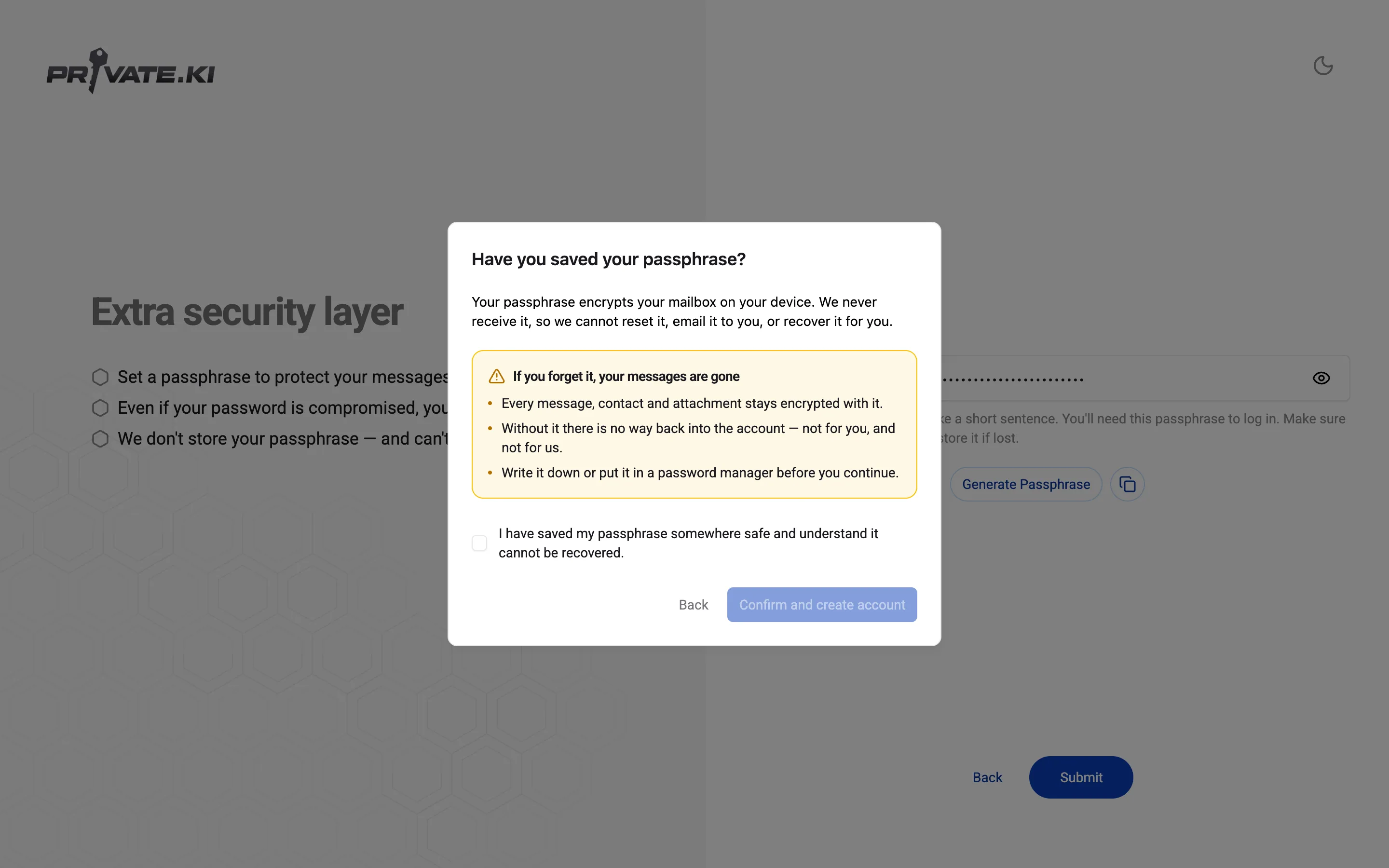
The passphrase itself is never sent to us. That is deliberate, and it has a consequence: we cannot reset it. If you lose your passphrase, there are zero ways to recover your key — not for us, not for anyone. The app makes you acknowledge this before the key is created.
A recovery address, if you set one, is for account notices. It cannot recover a passphrase.
The same story, with the real names
Everything above uses standard, published cryptography. Nothing is proprietary, and nothing depends on trusting us.
Keys
Each account has an Ed25519 key pair generated on the device with OpenPGP.js. The private key is encrypted with a master key derived from the passphrase (HKDF‑SHA‑256) and stored only in encrypted form. The passphrase and the master key never leave the device.
Messages
Every message body — mail or chat — is encrypted with AES‑256‑GCM under a fresh session key. That session key is encrypted to each recipient's public key using standard OpenPGP packaging, once per recipient. Messages are signed with the sender's private key; the app shows a padlock for encryption and a shield for a valid signature on every message.
Attachments, voice, reactions
Attachments and voice messages are encrypted on the device before upload and stored as ciphertext (25 MB per file). Reactions, unsend and destroy instructions and per‑message timers are carried inside encrypted messages, so the server cannot see what they refer to.
Transport and server
All traffic runs over TLS, on top of the end‑to‑end layer. The server stores ciphertext, public keys and delivery metadata. Mail from other providers arrives over SMTP and is encrypted to your key on arrival; its headers are readable to us at that moment.
Sign‑in and sessions
Sign‑in uses OPAQUE, so your password is never transmitted. Sessions are bound to a key on your device with DPoP. These protect access to your account; they are not part of message encryption. Details on the Account security page.
Audit status
An independent security audit is on our roadmap and has not been published yet. We say so rather than imply otherwise.
One address. Everything on it encrypted.
Free, no phone number, no invitation. Your keys are made on your device the moment you sign up.