Web app vs native apps: what differs
The same account, encryption and almost the same features everywhere. The short list of things that exist only on the web, in the apps, or on desktop.
Private.Ki is one application built once and run in three places: as a web app in any browser, and as native apps for iPhone and Android. Your account, your keys, your mail and chats are identical on all of them, and nearly every function works the same way. This page is the list of what does not — so you know which device to reach for.
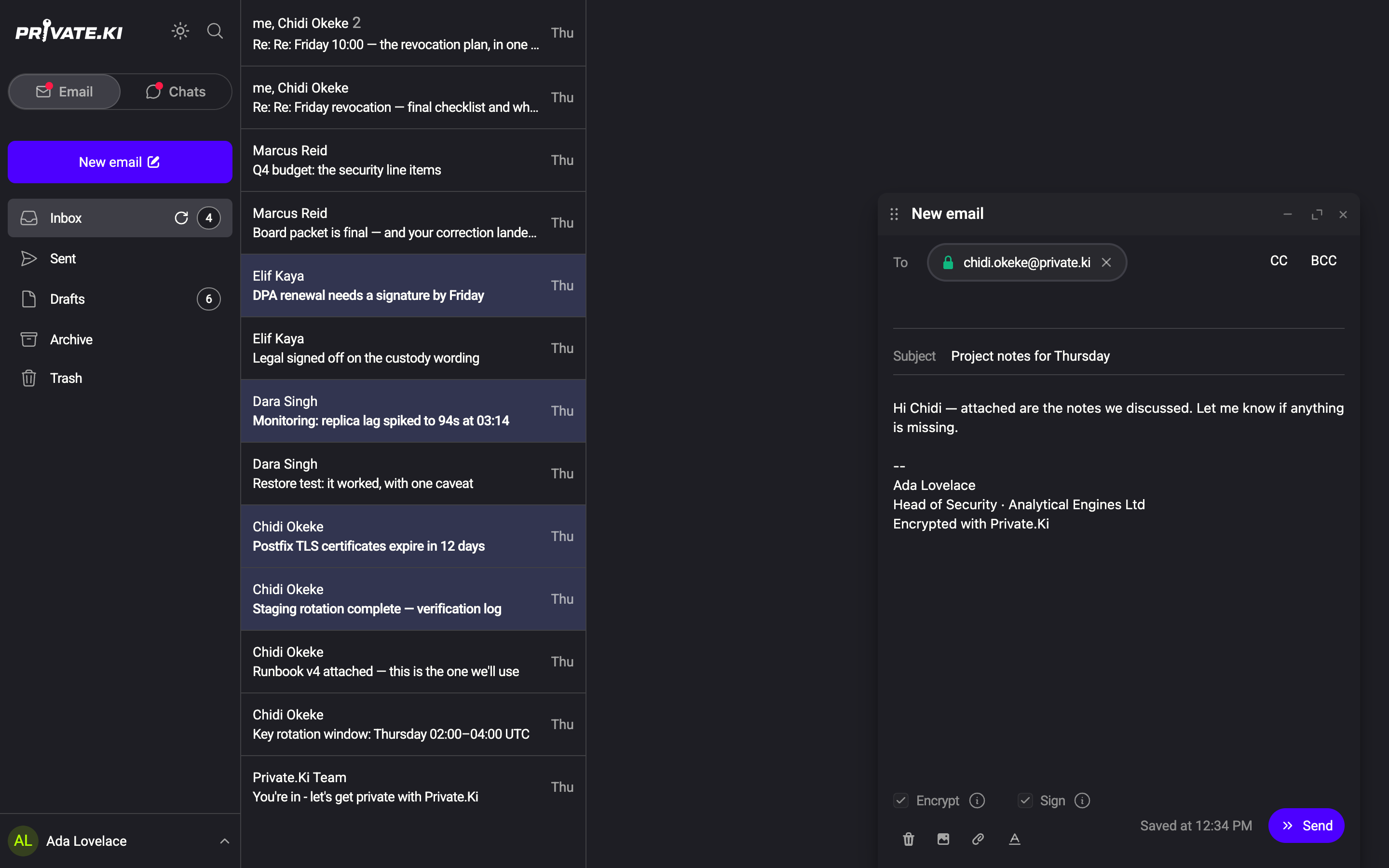
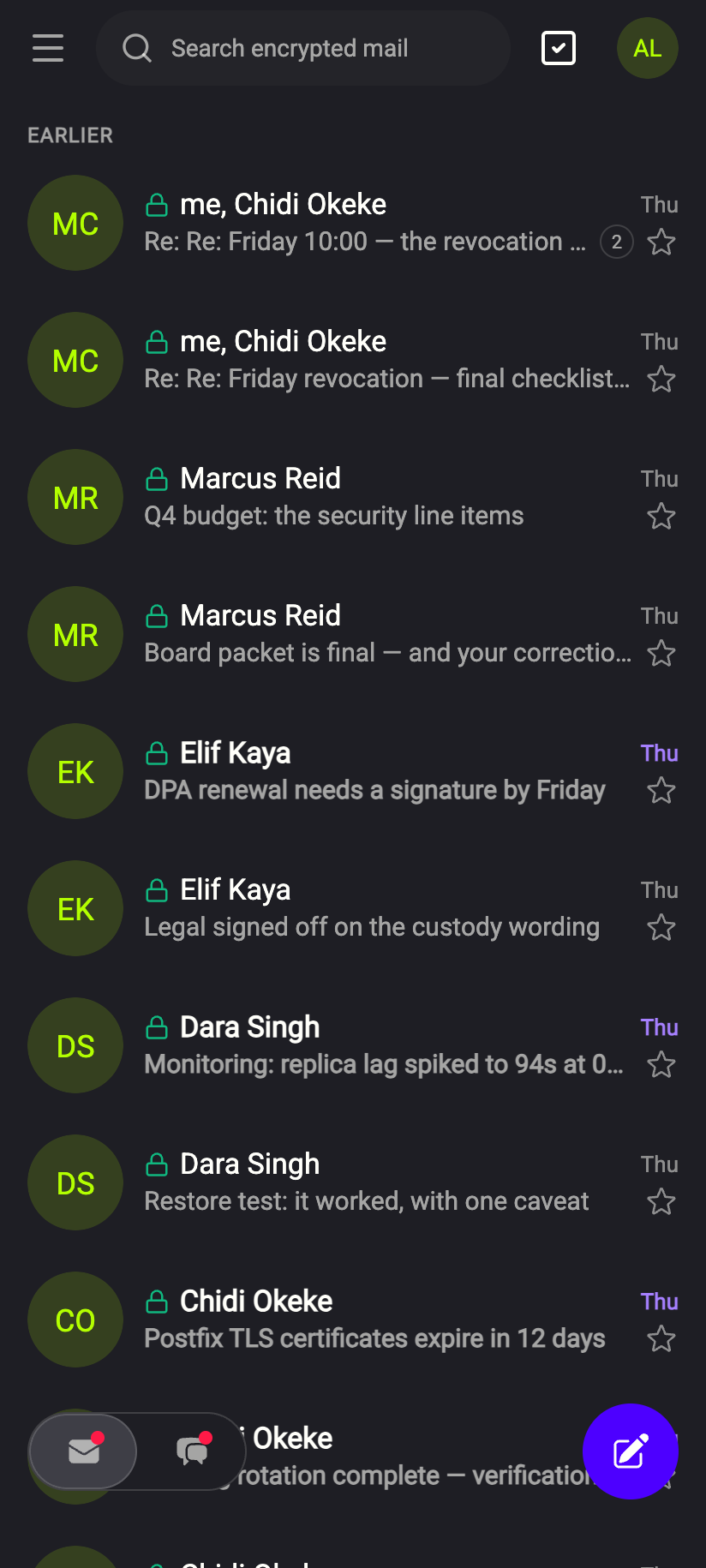
The differences fall into two groups. Some depend on the platform (browser vs native app). Others depend on the layout: the wide two-pane layout you get in a browser window over about 750 px, versus the single-column layout on every phone and in narrow windows.
Encryption: same result, different plumbing
On the web, encryption runs in the browser's own JavaScript engine using the OpenPGP.js library, with the browser's built-in Web Crypto for the local layer. In the native apps the very same cryptographic code runs inside a bundled WebView, and the app talks to it through a bridge. The keys, formats and results are identical — a message encrypted on one device decrypts on any other — and in both cases the private key is unlocked on the device and never sent anywhere. See How encryption works.
Only in the native apps (iPhone, Android)
| Feature | Notes |
|---|---|
| Push notifications | New email / New chat message while the app is closed. See Push notifications. |
| PIN and biometric unlock | A 4-digit PIN with Face ID or fingerprint instead of typing your password or passphrase each time. See PIN and biometric unlock. |
| Stored passphrase (iOS) | With the passphrase unlock method, the iPhone app can keep the passphrase in the device's secure storage so the PIN opens it. |
| Camera and photo permissions | The app asks for camera and photo-library access to attach images; the browser asks its own way. |
The apps are not yet in the App Store or Google Play. See Install Private.Ki on iPhone and Android.
Only in the web app
| Feature | Notes |
|---|---|
| Keyboard shortcuts | About a dozen — switch workspace, new message, move through lists, Esc Esc to lock. They do nothing in the native apps. See Keyboard shortcuts. |
| Right-click context menus | On mail rows and chat messages. On the phone, long-press does the same. |
| Tab title unread count | (3) Mail - Private.Ki in the browser tab. |
Only in the wide desktop layout (web, window wider than ~750 px)
| Feature | Notes |
|---|---|
| Multiple composer windows | Each New email opens a floating window you can move, minimise and maximise; several can be open at once. See Multiple composers. |
| Drag an email to a folder | Drag a row from the list onto Inbox, Archive or Trash in the sidebar. See Drag to folder. |
| List and reading pane side by side | And the sidebar with the Email / Chats toggle at the top. |
| Collapsible sidebar in Chats | Hide the sidebar to give the conversation the width. |
| Search from the sidebar | The magnifier in the sidebar, or / and ⌘ + K. |
Only in the single-column layout (phones, native apps, narrow windows)
| Feature | Notes |
|---|---|
| Swipe actions on rows | Swipe a mail row one way to archive, the other to trash; swipe a chat row to delete; 6 seconds to undo. See Swipe and bulk actions. |
| Swipe to switch or open the drawer | Across empty space in a list: one direction toggles Email ⇄ Chats, the other opens the folder drawer ☰. See Switch between Email and Chats. |
| Bulk selection header | The tick icon at the top of the list selects several emails for one action. |
| Full-screen composer | One composer at a time, filling the screen. |
| Search bar at the top | Search encrypted mail above the list instead of the sidebar magnifier. |
| Floating Email / Chats pill | At the bottom of the screen, with the compose button beside it. |
A phone browser gets this layout too, so on a phone the web app and the native app look and behave almost identically; the native app adds only the first table above.
The same everywhere
Everything not listed: composing and sending, Encrypt and Sign switches, attachments (10 × 25 MB), signatures, undo send, folders, stars, subject-and-people search, external image blocking, tracking protection, show original, importing and exporting keys, 1:1 and group chats, invite links and QR codes, self-destruct timers, unsend and destroy, reactions, voice messages, typing indicators, two-factor authentication, recovery address, active sessions, QR sign-in (scanning and showing a code — a computer with a camera can scan too), themes, the 30-minute offline lock. Getting started links to the article for each.
 123123
What our server sees
Cannot see
- Which platform you are on beyond what any web server sees — the browser or app identifies itself in each request
Can see
- Which of your devices holds a session, and, for the native apps, a push token and the device name
Common questions
Is one platform more secure than another?
No. The same code, the same keys, the same protocol. Choose by convenience: the phone app for notifications and PIN unlock, the desktop browser for keyboard, drag and drop and several composers.
Can I use both at once?
Yes. Sign in on as many devices as you like; pair a phone by QR in seconds. Each device unlocks separately. See Pair a second device.
Why does my desktop browser suddenly look like the phone version?
The window got narrower than about 750 px — for example when you docked it beside another window. Widen it and the two-pane layout comes back.
Is there a Windows, Mac or Linux desktop app?
No. The web app is the desktop app.